- Products
- Solutions
Real-Time Analytics
Sub-second dashboards and data products on petabytes of data at any concurrency
Data Warehousing
Sub-second analytics on open lakehouse formats with no vendor lock-in
Observability in the AI Era
The most cost-effective alternative to Elasticsearch observability
Context Engineering
Hybrid search and fresh context for RAG, agents, and LLMs
- Docs
- Resources
- Pricing
- Contact us







The unified real-time database
for observability
- SELECT61%
- INSERT18%
- UPDATE12%
- DELETE9%

From AI labs to global scale

PB-scale AI logging at 70% lower cost
Replaced a Grafana Loki stack with an Apache Doris–based logging system to store and query model training and inference logs at petabyte scale.

One unified lakehouse, 6× faster queries
Consolidated Presto, Druid, Kudu, and Trino into a single Apache Doris + Paimon lakehouse running across 40+ clusters on petabytes of data.
Real-time DeFi analytics across 190+ chains
Migrated from PostgreSQL to VeloDB Cloud to serve 10M+ users with real-time on-chain analytics spanning 190+ blockchains and 500+ DEXs.
Billion-scale hybrid search, 7× faster
Built hybrid search on Apache Doris 4.0 — combining filters, BM25, and vector similarity over 1B+ embeddings — on a single server.
10,000+ Enterprises Trust Apache Doris and VeloDB





































Built for the workloads that
break ordinary databases
Real-Time performance under real-world conditions
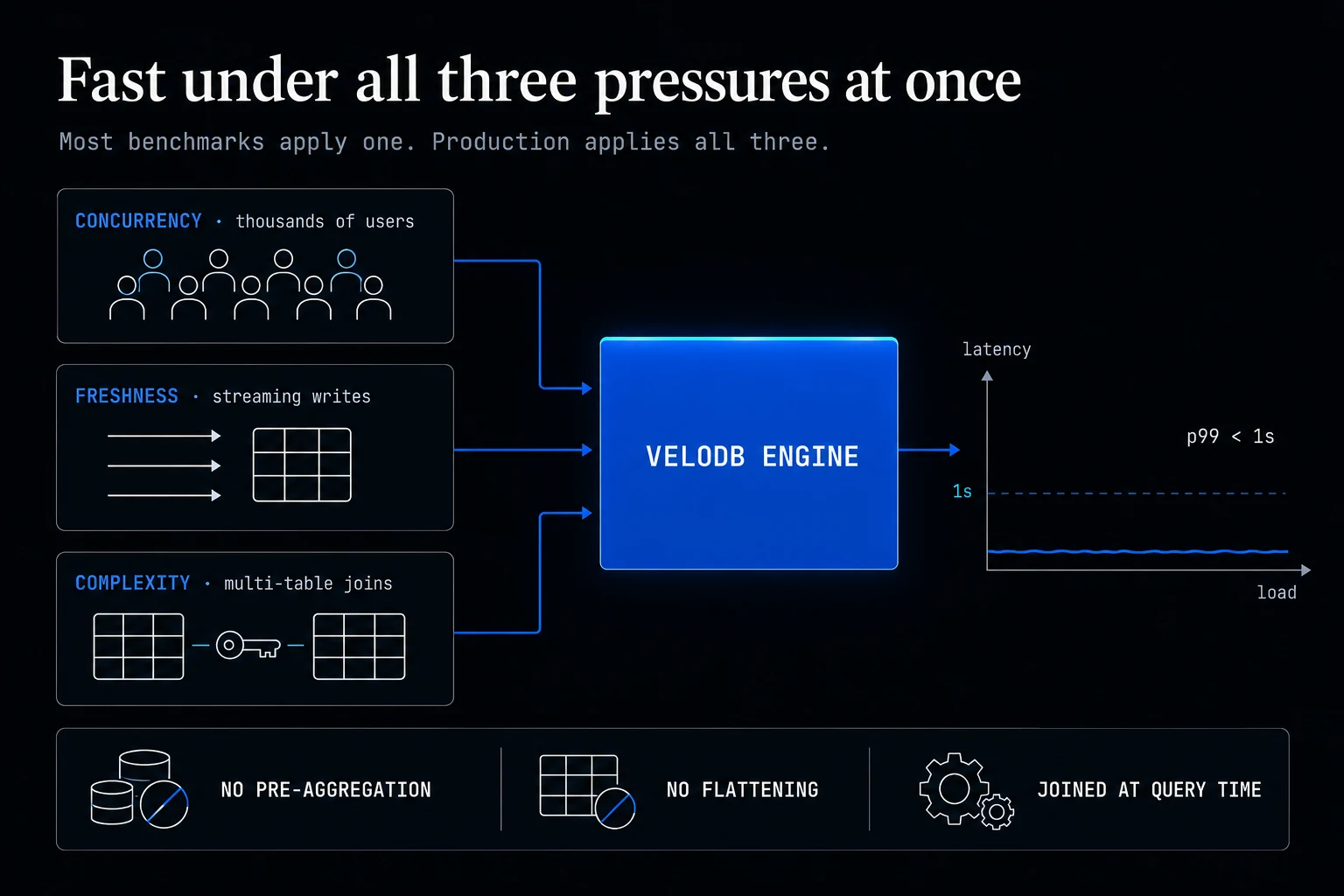
Sub-second latency under concurrency, heavy updates, and complex joins — all at once.
Most databases benchmark on clean, single-table scans. Real workloads often face the following challenges: thousands of concurrent users, data that changes by the hour, and multi-table joins. VeloDB is engineered to hold sub-second latency through all these challenges, so dashboards, data products, and AI apps stay fast as the workloads scale.
Unified analytics, search, and AI retrieval
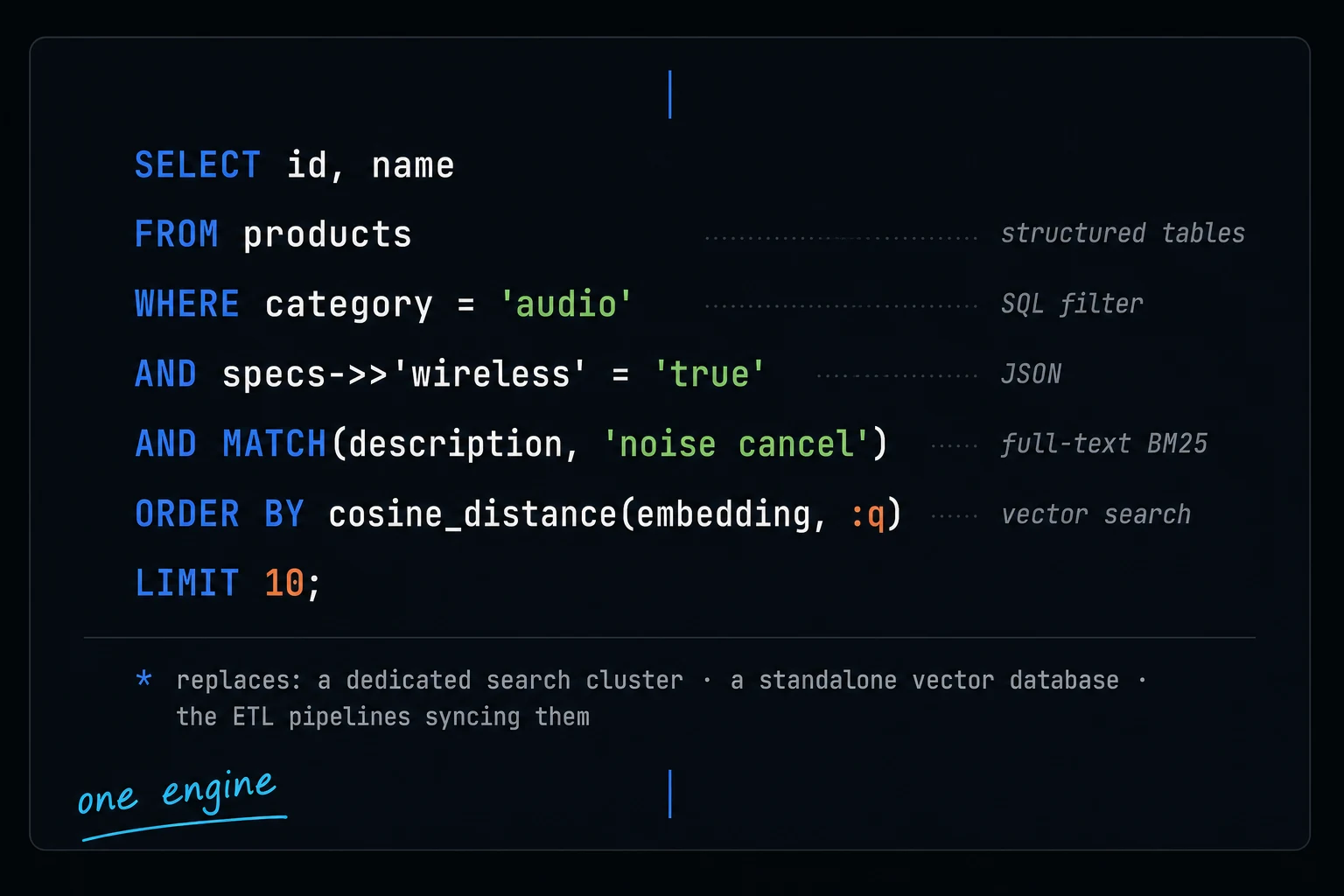
One engine for multimodal data, queried in standard SQL.
Structured tables, semi-structured JSON, full-text, and vector embeddings are stored in one place and queried with a single engine and a single SQL statement. Reduce the number of databases you have to manage and maintain so you can focus on innovation.
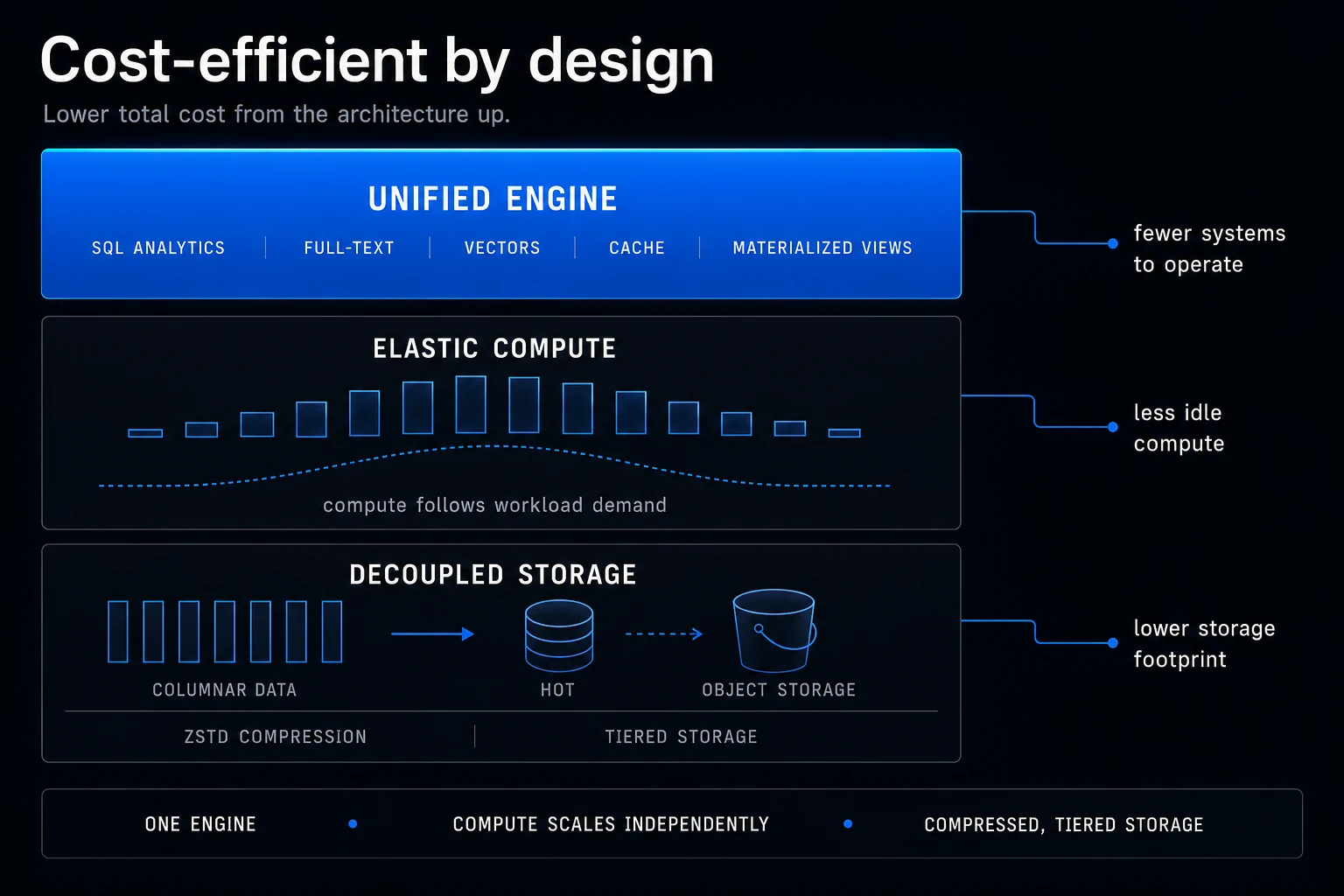
Cost-efficient by design
Efficiency from the architecture and up.
Most analytics costs come from running and maintaining many separate systems. VeloDB lowers those costs by simplifying the stack. It replaces the search database, vector store, Redis cache, and surrounding ETL layers with built-in caching and materialized views. VeloDB Cloud separates storage and compute while integrating with open lakehouse, so compute scales elastically, and bursty agent workloads only cost you while they run. On top of that, Doris uses columnar ZSTD compression and tiered object storage to bring down storage costs.
Open by default
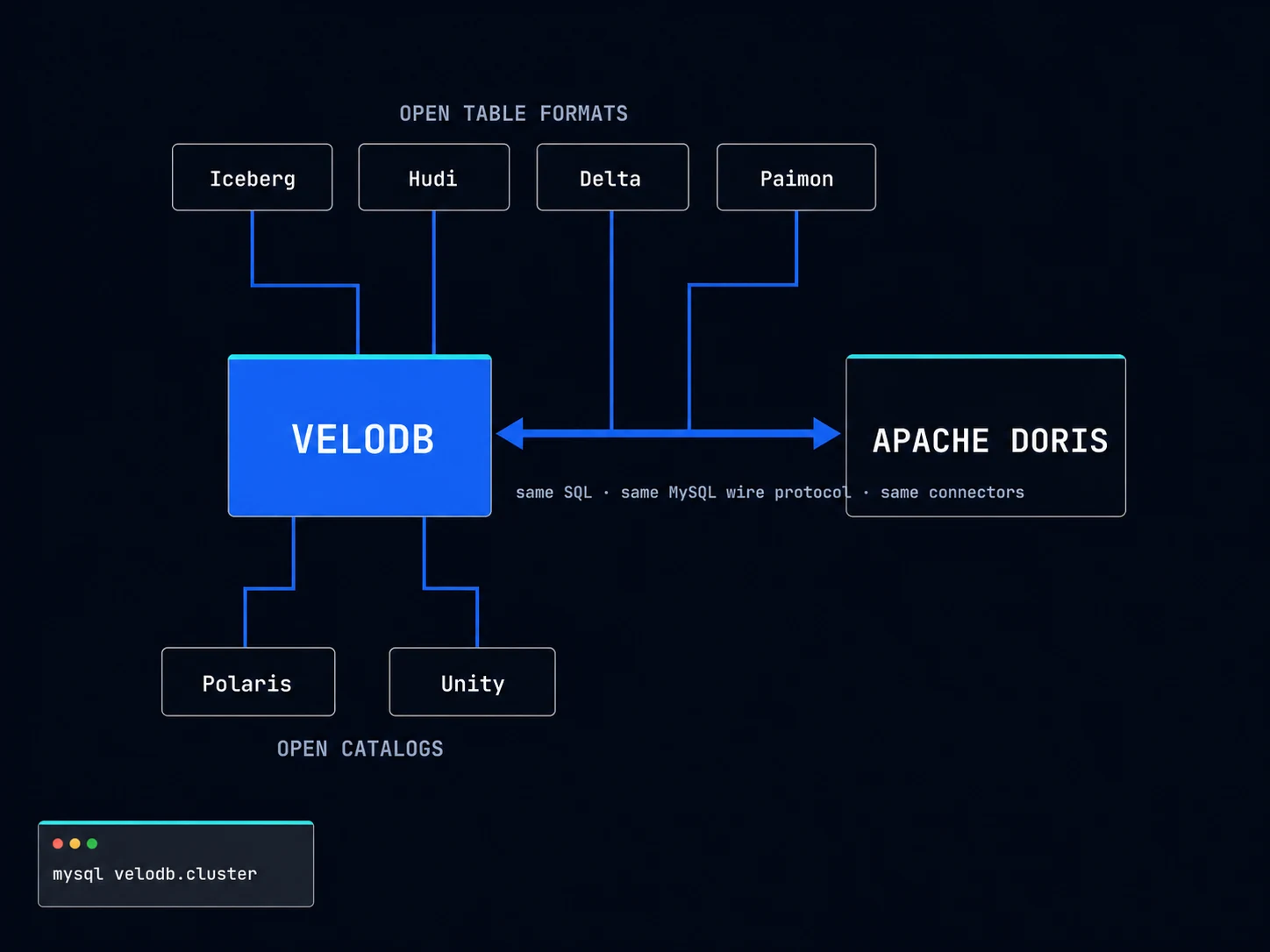
Truly open, fully compatible with the open-source Apache Doris.
VeloDB is built on Apache Doris and stays fully compatible with it. You get the same SQL, the same MySQL wire protocol, and the same connectors as the open-source project, so anything you build on Apache Doris runs on VeloDB without changes and ports back just as easily. VeloDB also integrates with open catalogs like Polaris and Unity, and open table formats like Iceberg, Hudi, and Delta.
One engine, four workloads,
zero ETL between them
Real-Time Analytics
Sub-second dashboards and data products on petabytes of data at any concurrency.
Data Warehousing
Sub-second analytics on open lakehouse formats with no vendor lock-in.
Observability in the AI Era
The most cost-effective alternative to Elasticsearch observability.
Context Engineering
Hybrid search and fresh context for RAG, agents, and LLMs.
The unified engine at the center of your data ecosystem
Unify data ingestion, lakehouse access, analytics, search, and AI workloads in one engine.
 Power BI
 Tableau
 Looker
 Superset
 dbt
dbt Flink
Flink OpenTelemetry
 Grafana
 Langfuse
 RAY
RAY LangChain
 LlamaIndex
 Dify
Dify Powered by Apache Doris
 MySQL
MySQL PostgreSQL
 MongoDB
 kafka
kafka Confluent
 Amazon S3
 Google Cloud Storage
 Azure Data Lake
 Fivetran
 Airbyte
 Hadoop HDFS
 Iceberg
 Delta Lake
 Apache Hive
 LanceDB
 AWSGoogle CloudMicrosoft Azure
 Kubernetes
 On-prem
Ship on the unified real-time database
Analytics, search, and AI retrieval in one engine — open source, MySQL-compatible, runs in your cloud.
Recent News
 User StoriesHow StepFun Built a PB-Scale Agent Observability Platform with Apache DorisStepFun built StepTrace, a PB-scale agent observability platform on Apache Doris.2026/7/8
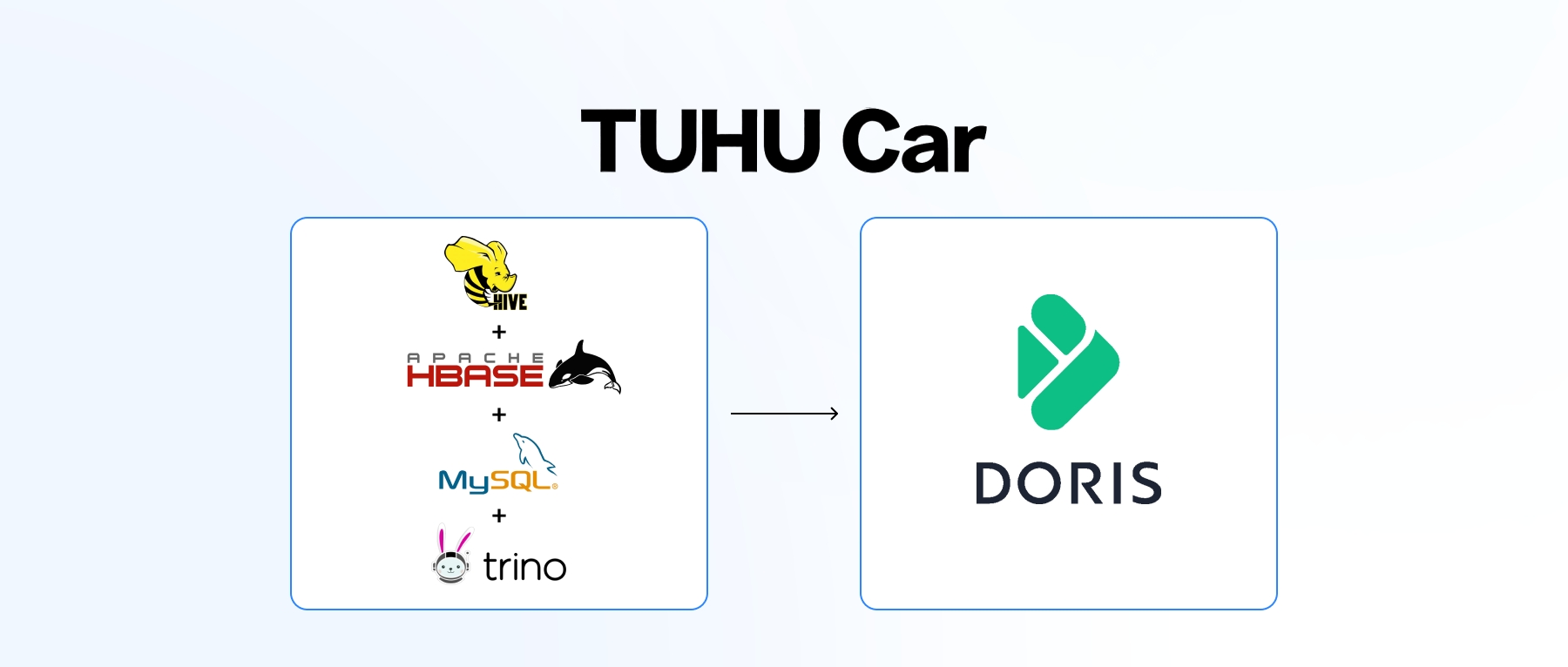 User StoriesFrom Hive, HBase, MySQL, and Trino to Apache Doris: Tuhu Car's Unified OLAP ArchitectureTuhu Car rebuilt its OLAP architecture with Apache Doris after years of running a fragmented tack of Hive, HBase, MySQL, and Trino.2026/7/3
 ProductsWhy AI Agents Need Real-Time Analytics and Hybrid Search: The Data Infra for Production AgentsAI agents need real-time analytics, not just vector search. Apache Doris unifies both capabilities, offering native hybrid search, in one real-time engine built for agent workloads.2026/6/24

© 2026 VeloDB Inc. All rights reserved. Apache Doris and its logo are trademarks of The Apache Software Foundation